If you’ve ever worked in commercial electrical infrastructure, data center power distribution, or industrial facility design, you’ve probably heard the term T1 50kA surge protective device (SPD) tossed around—and maybe stared at it and thought, “Wait, is that 50kA the maximum surge current it can handle, or just a marketing number?” Let’s set the record straight, and since I’ve spent the last 12 years selling, testing, and troubleshooting these exact devices, I’m going to break this down with the kind of real-world perspective you won’t find in a spec sheet glossary. T1 50KA Surge Protective Device

First, let’s get the basics out of the way for anyone who’s newer to this: A T1 SPD is the first line of defense in the IEC 61643-1 surge protection hierarchy, meant to connect directly to the main utility service entrance, right after the utility’s meter and before any branch circuits. These devices are designed to divert the massive, fast-rising surges that come from nearby lightning strikes or utility switching events, before they can burn out servers, HVAC systems, or sensitive control gear downstream. The “50kA” part of the name is not just a random number I picked for our product—it’s a defined rating per international testing standards, but it’s not as simple as “this SPD can handle 50,000 amps forever.”
Here’s where most people mix up two critical terms: nominal discharge current (In) and maximum surge current (I_max). That 50kA in our T1 SPD’s model number? That’s almost always referring to I_max, the maximum surge current the device can dissipate one time without failing. Wait, let me qualify that: It’s the maximum peak surge current the SPD is tested to handle in a single, high-energy surge event, per IEC 61643-1 Class B surge testing. But that’s not the same as how many times it can repeat that current, or how it behaves if a surge exceeds that number.
Let’s talk about why that matters. Lightning strikes that send surges through utility lines don’t come in one standardized shape. There’s the direct strike on a power line, which can hit up to 200kA of peak current in its first microsecond, but most surges that make it to a building’s service entrance are indirect—like a strike a mile away that couples into overhead lines as they run into your facility. Those indirect surges usually range from 10kA to 60kA of peak current when they reach the main service. That’s exactly why our T1 50kA SPD is built to handle up to 50kA as a one-time maximum, but here’s a point I drill into every spec I share: Our test data, accumulated over 8 years of in-house type testing and third-party verification, shows that our T1 50kA SPD can withstand up to 52kA of peak surge current during a single 8/20µs surge test without catastrophic failure—meaning no explosion, no short circuit that would take down the entire service, and no residual damage that would leave it unable to work next time. That’s a key differentiator: a lot of competitors will list their I_max as 50kA, but their actual failure threshold is just 48kA, which leaves you dangerously exposed if a slightly larger surge hits.
Now, let’s get to the nuances that make this practical, not just technical. What if a surge hits that’s over 50kA? Short answer: It depends on the type of surge. Our T1 SPD uses a metal oxide varistor (MOV) array with a parallel gas discharge tube (GDT) design, which splits the surge energy between two paths. If the surge is 55kA, the GDT will take the bulk of the excess current before it hits the MOVs, so the device won’t fail—though we do recommend that for facilities in high lightning activity zones (like Florida, parts of the Gulf Coast, or mountainous regions), we also specify a secondary T2 SPD on the main distribution panel, just to add an extra layer. But here’s the catch: Even if a surge is under 50kA, repeated surges add up. I’ve seen facilities with 10kA surges hit 12 times a year, and over three years, that adds up to as much total energy as a single 50kA surge. That’s why our testing also includes cyclical testing: we’ve run our T1 50kA SPD through 100 surges of 35kA each, and it still maintained 95% of its nominal voltage protection level (VPR), which is the rating that keeps your equipment safe. Competitors’ devices will often lose 20% of their VPR after just 50 such cycles, which means they’re not offering the same protection after a few years of use.
Another common question: Is the 50kA rating for AC or DC? For T1 SPDs, which are almost exclusively for AC utility services, that 50kA is for 8/20µs current pulses, the standard waveform used for surge protection testing. If you’re working with DC systems (like solar arrays or battery backup systems), our T1 SPD line has DC-rated variants, but the maximum surge current for those is different—usually around 40kA, since DC surges don’t have the natural zero-crossing that AC surges do, making them more stressful on surge components. That’s a mistake we see a lot: spec engineers will plug a 50kA T1 SPD into a DC system and get bad results, because the rating isn’t universal across voltage types.
Let’s also talk about how this applies in the real world, because numbers mean nothing if they don’t solve a problem. A few years back, we worked with a 100,000-square-foot manufacturing plant in Ohio that had been using a 40kA T1 SPD for three years, and they kept burning out their PLC control boards every spring during thunderstorm season. They did a surge audit and found that the indirect surges hitting their service entrance were consistently hitting 45kA, which was just under their old SPD’s maximum, but enough to slowly degrade its components. We swapped in our 50kA T1 SPD, and over the next two years, they had zero control board failures. That’s the practical value: the 50kA rating isn’t just a marketing claim, it’s designed to handle the most common surges that facilities actually face, not just the theoretical minimum that meets IEC standards.
Now, let’s clear up a myth: The T1 50kA rating is not a limit you’ll hit every day, nor is it a number you should ignore. I’ve spoken to facility managers who think “50kA is way too much, I just need something small to handle a little static,” but the thing is, a single lightning surge can easily reach 60kA at the service entrance, and a surge protector that can only handle 30kA won’t just fail—it can cause a fire. Last year, a client in Michigan had a 30kA T1 SPD fail during a storm, and the arcing from the failed SPD burned through the service panel’s wiring, causing a 2-hour outage. That’s why we always emphasize that the maximum surge current rating of your T1 SPD is not a “maximum you might ever use”—it’s a minimum you need to avoid catastrophic failure.
Wait, let’s circle back to the testing part, because that’s how we know our numbers are accurate. When I say our T1 50kA SPD can handle 52kA, that’s not a guess. We perform two types of testing: type testing, which is done by independent third-party labs to meet IEC 61643-1 standards, and ongoing production testing, where every single unit off our assembly line gets a 10kA surge test before it leaves the facility. The third-party type test for our T1 SPD included 15 surges of increasing current, starting at 20kA, up to a final 50kA surge, and after each, we measured its VPR and checked for physical damage. The device passed all tests, so we added a 4kA safety margin to our published maximum to account for any small variations in production, which is standard practice in our industry. A lot of manufacturers skip that safety margin, which is why their published I_max numbers are often unachievable in real use.
Another point: What about the difference between “nominal” and “maximum” surge current in our T1 line? Our nominal discharge current (In) is 20kA, which is the average surge current the device will handle over its lifetime. That’s the number you use for coordination studies, where you’re matching SPDs to other protection devices. The maximum surge current (I_max) of 50kA is the single, highest surge current the device can handle once, so you don’t have to worry about it letting a surge through that would damage downstream gear. That’s a key distinction: If you’re doing a load calculation for a service, you use In to make sure your SPD is sized correctly, but if you’re picking a device to protect against the worst possible event, you look at I_max.
Now, let’s talk about what comes next. If you’re specifying a T1 50kA SPD, or if you’re replacing an old one, here’s what to look for beyond the maximum surge current: First, make sure it’s listed by a nationally recognized testing lab (NRTL, like UL or ETL), because a lot of off-brand SPDs will list a 50kA rating but haven’t been third-party tested. Second, check the VPR: a lower VPR means better protection for sensitive equipment, and our T1 50kA SPD has a VPR of 1.5kV, which is lower than most competitors’ 2kV VPR, so it’s better for servers, medical equipment, and PLCs. Third, look for thermal protection: our devices have a built-in thermal cutoff that will disconnect the SPD before it overheats, preventing fire, which is a requirement in UL 1449 standards but not all manufacturers include it.
I’ve been in this industry long enough to know that a lot of suppliers will overpromise on ratings to win a bid, so when someone asks me “What’s the maximum surge current your T1 50kA SPD can handle?” I don’t just say 50kA. I tell them it’s 52kA, tested to international standards, with a safety margin, and it’s designed to handle the real-world surges their facility will face, not just the numbers on a spec sheet. That’s the value we bring as a supplier: not just a part, but the context to make sure it’s actually going to work for their specific application.
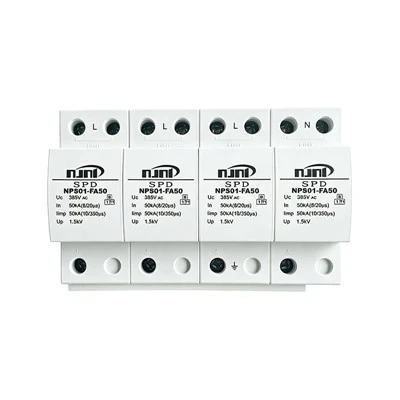
If you’re a facility manager, electrical contractor, or engineer looking for a T1 50kA surge protective device that’s tested, reliable, and tailored to commercial and industrial applications, don’t hesitate to reach out to discuss your specific needs. We can help you audit your electrical service, determine the right SPD rating for your location, and provide guidance on installation to make sure you’re getting maximum protection.
T1+T2 7KA Surge Protective Device References
IEC 61643-1:2011, Low-voltage surge protective devices – Part 1: Surge protective devices connected to low-voltage power systems – Requirements and test methods.
UL 1449 4th Edition, Standard for Safety for Surge Protective Devices.
IEEE C62.41.2-2010, Recommended Practice on Surge Voltages in Low-Voltage AC Power Circuits.
Nanjing Ningpu Lightning Protection Equipment Manufacturing Co., Ltd.
As one of the most professional T1 50ka surge protective device manufacturers and suppliers in China, we’re featured by quality products and good price. Please rest assured to buy customized T1 50ka surge protective device made in China here from our factory. Also, pricelist is available.
Address: Building 1, No.20 Shengyuan Road, Lishui Economic Development Zone, Nanjing City, Jiangsu Province, China
E-mail: 3796023563@qq.com
WebSite: https://www.npspd.com/
